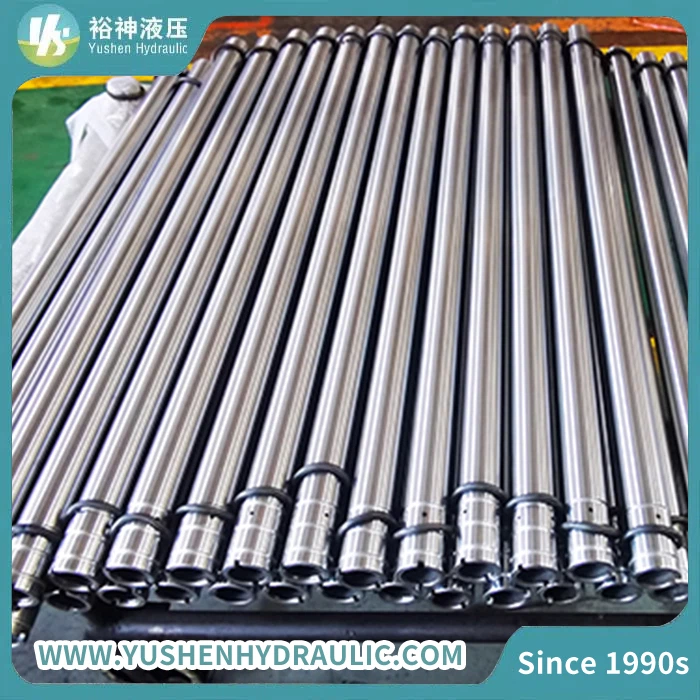
Hey there! As a supplier of S45C piston rods, I often get asked about the surface roughness requirements for these rods. So, I thought I'd take some time to break it down for you all.
First off, let's talk a bit about S45C. S45C is a high - quality carbon steel that's widely used in the manufacturing of piston rods. It has good strength, toughness, and wear - resistance properties, making it a popular choice in various industries like automotive, hydraulic, and machinery.
Surface roughness is a crucial factor when it comes to piston rods. Why? Well, the surface finish of a piston rod can significantly impact its performance and lifespan. A rough surface can cause increased friction between the piston rod and other components, like the seals and bearings. This friction can lead to premature wear and tear, energy loss, and even leakage in hydraulic systems. On the other hand, a smooth surface reduces friction, improves the efficiency of the system, and enhances the overall durability of the piston rod.
So, what exactly is the surface roughness requirement for S45C piston rods? Generally, the surface roughness of S45C piston rods is specified in terms of Ra (arithmetical mean deviation of the profile). For most applications, the Ra value for S45C piston rods typically ranges from 0.2μm to 0.8μm.
In applications where the piston rod operates in a high - precision environment, such as in some advanced hydraulic cylinders, a lower Ra value, around 0.2μm - 0.4μm, is required. This ultra - smooth surface finish ensures minimal friction and precise movement of the piston, which is essential for the accurate operation of the hydraulic system.


For more general - purpose applications, like in some industrial machinery where the operating conditions are not as stringent, an Ra value of 0.4μm - 0.8μm is usually acceptable. This surface finish still provides a good balance between reducing friction and the cost of manufacturing.
Achieving the right surface roughness for S45C piston rods involves several manufacturing processes. First, the raw S45C steel is usually machined to get the basic shape of the piston rod. Then, grinding is often used to further refine the surface. Grinding can effectively reduce the surface roughness and improve the dimensional accuracy of the rod. After grinding, in some cases, honing may be carried out. Honing can create a very smooth and uniform surface finish, which is especially useful for achieving the lower Ra values required in high - precision applications.
Another important process is chrome plating. Chrome plating not only enhances the corrosion resistance of the S45C piston rod but also improves its surface hardness and smoothness. Chrome Plated Smooth Rod is a great example of how chrome plating can transform the surface properties of a piston rod. A hard chrome - plated surface can reduce friction even further and protect the rod from wear and corrosion in harsh operating environments. Hard Chrome Plated Cylinder Rod is specifically designed for applications where high - performance and long - lasting piston rods are needed.
When it comes to pairing S45C piston rods with other components, the surface roughness also plays a role. For instance, when using S45C piston rods in hydraulic cylinders, they are often paired with H9 Hydraulic Cylinder Steel Honed Tube. The surface roughness of the tube and the piston rod need to be compatible to ensure proper sealing and smooth movement within the cylinder. If the surface roughness of the piston rod is too high, it can cause damage to the seals in the tube, leading to leakage and reduced performance of the hydraulic system.
In addition to the technical aspects, understanding the surface roughness requirements is also important from a cost - effectiveness perspective. Manufacturing a piston rod with a very low Ra value requires more advanced equipment and processes, which can increase the production cost. So, it's essential to determine the appropriate surface roughness based on the specific application requirements. Over - specifying the surface roughness can lead to unnecessary costs, while under - specifying can result in poor performance and frequent replacements.
As a supplier of S45C piston rods, I always work closely with my customers to understand their needs. Whether they need a high - precision piston rod for a complex hydraulic system or a more cost - effective solution for a general industrial application, I can provide the right product. I have a team of experienced engineers who are well - versed in the manufacturing processes of S45C piston rods. They use state - of - the - art equipment to ensure that the surface roughness and other specifications of the piston rods meet the highest standards.
If you're in the market for S45C piston rods, don't hesitate to reach out. I'm here to offer you the best products and solutions tailored to your specific requirements. Whether you have questions about surface roughness, manufacturing processes, or any other aspect of S45C piston rods, I'll be more than happy to help. Let's work together to find the perfect S45C piston rod for your application.
References:
- "Handbook of Mechanical Engineering Design"
- "Materials Science and Engineering: An Introduction"