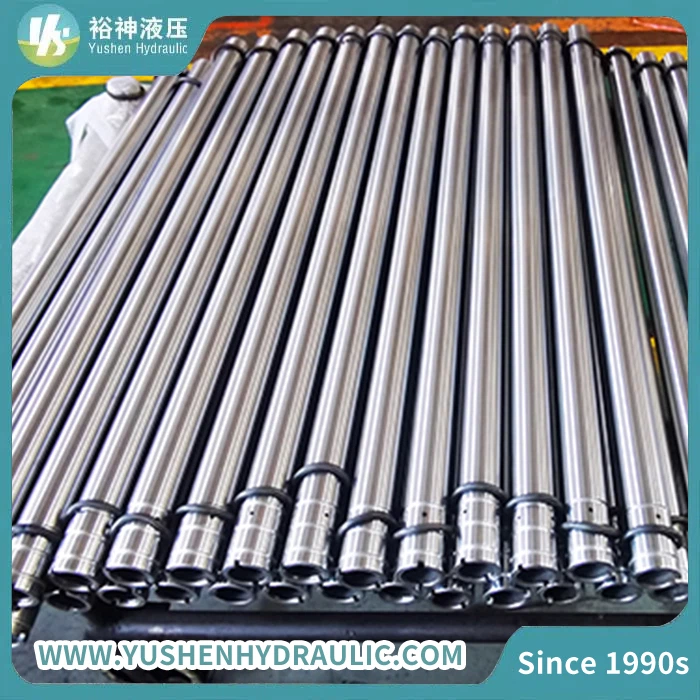
Hey there! As a supplier of stainless steel piston rods, I've been keeping a close eye on the industry trends. In this blog, I'll share some insights into what the future holds for the development of stainless steel piston rods.
1. Material Advancements
One of the most significant trends in the future of stainless steel piston rods is the continuous improvement of materials. We're seeing a move towards high - performance stainless steel alloys that offer better corrosion resistance, higher strength, and improved fatigue life.
New manufacturing processes are enabling us to create alloys with a more uniform microstructure. This uniformity enhances the mechanical properties of the piston rods. For example, some of the latest alloys can withstand harsher chemical environments, which is a huge advantage in industries like chemical processing and marine applications.
In addition, research is being done on adding trace elements to stainless steel to further enhance its properties. These trace elements can improve the hardness, toughness, and wear resistance of the piston rods. As a supplier, I'm excited about these advancements because they allow us to offer better products to our customers.
2. Precision Manufacturing
Precision is becoming increasingly important in the manufacturing of stainless steel piston rods. With the development of advanced machining technologies, we're able to produce piston rods with extremely tight tolerances.
Computer Numerical Control (CNC) machining has revolutionized the industry. It allows for highly accurate and repeatable manufacturing processes. We can now produce piston rods with diameters and lengths that are accurate to within a few micrometers. This level of precision is crucial in applications where the piston rod needs to fit perfectly into a hydraulic or pneumatic cylinder.
Another aspect of precision manufacturing is surface finish. A smooth surface finish not only reduces friction but also improves the sealing performance of the piston rod. New polishing and grinding techniques are being developed to achieve an even smoother surface. For instance, super - finishing processes can produce a surface finish with a roughness average (Ra) of less than 0.1 micrometers.
3. Customization
Customers are increasingly demanding customized stainless steel piston rods. Different industries have different requirements, and a one - size - fits - all approach just doesn't work anymore.


In the automotive industry, for example, piston rods need to be lightweight yet strong to improve fuel efficiency. On the other hand, in heavy machinery, piston rods need to be able to withstand high loads and pressures. As a supplier, we're investing in the ability to customize our products to meet these diverse needs.
We can customize the size, shape, and material of the piston rods according to the customer's specifications. Whether it's a Hollow Piston Rod for Hydraulic Cylinder for a specific hydraulic system or a Hard Chromed Plated Piston Rod with a particular chrome thickness, we're able to deliver.
4. Environmental Sustainability
Sustainability is a major trend in almost every industry, and the stainless steel piston rod industry is no exception. We're seeing a growing demand for environmentally friendly manufacturing processes and products.
Stainless steel is already a relatively sustainable material because it's recyclable. However, we're looking for ways to reduce the environmental impact of our manufacturing processes. This includes reducing energy consumption, minimizing waste, and using more eco - friendly chemicals.
For example, some of the traditional chrome - plating processes use chemicals that are harmful to the environment. We're exploring alternative plating methods that are more sustainable. Additionally, we're implementing energy - efficient manufacturing equipment to reduce our carbon footprint.
5. Integration of Smart Technologies
The future of stainless steel piston rods is likely to involve the integration of smart technologies. In the era of the Internet of Things (IoT), piston rods can be equipped with sensors to monitor their performance in real - time.
These sensors can measure parameters such as temperature, pressure, and vibration. By collecting this data, we can detect potential problems before they lead to a breakdown. This predictive maintenance approach can save our customers a lot of money in terms of downtime and repair costs.
For example, if a sensor detects an abnormal increase in temperature in a piston rod, it can send an alert to the maintenance team. The team can then take preventive action, such as adjusting the lubrication or inspecting for wear.
6. Market Expansion
The demand for stainless steel piston rods is expected to grow in various industries. In the construction industry, the increasing use of heavy machinery means more demand for high - quality piston rods. The aerospace industry also requires piston rods that are lightweight and have high strength - to - weight ratios.
In the medical field, stainless steel piston rods are used in various devices such as surgical equipment and diagnostic machines. As the global population ages and the demand for medical services increases, the market for these types of piston rods is likely to expand.
Why Choose Us as Your Supplier?
As a leading supplier of stainless steel piston rods, we're at the forefront of these industry trends. We have the expertise and resources to produce high - quality, customized piston rods that meet the needs of different industries.
Our commitment to precision manufacturing ensures that you'll get piston rods with the exact specifications you require. We use the latest manufacturing technologies and materials to offer products that are durable, reliable, and environmentally friendly.
Whether you need a Piston Shaft for a specific application or a large batch of standard piston rods, we can help. We have a dedicated team of professionals who are ready to assist you throughout the procurement process.
If you're interested in learning more about our stainless steel piston rods or have specific requirements, please don't hesitate to reach out to us. We're eager to discuss your needs and work with you to find the best solutions.
References
- "Materials Science and Engineering: An Introduction" by William D. Callister Jr. and David G. Rethwisch
- "Manufacturing Engineering and Technology" by S. Kalpakjian and S. R. Schmid
- Industry reports from market research firms specializing in the metal manufacturing sector