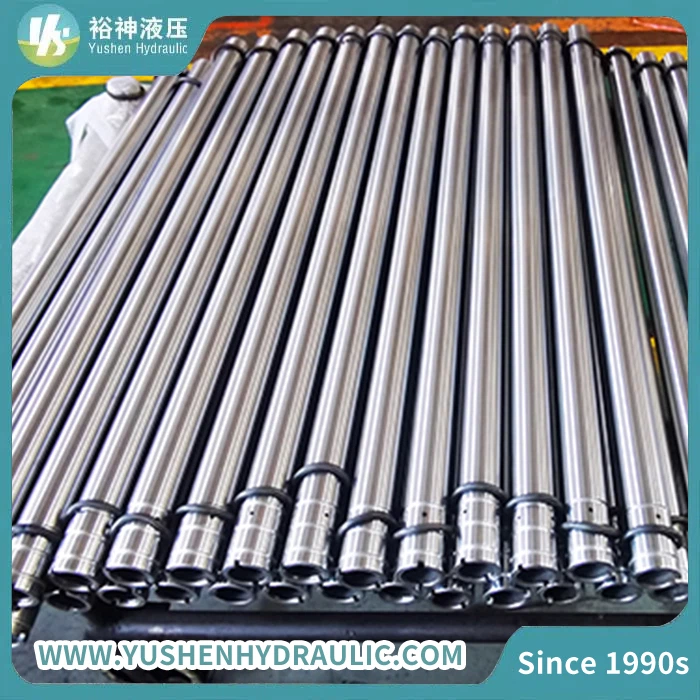
Hey there! As a supplier of Hollow Piston Rods, I often get asked about the flow rate through these rods. So, let's dive right into it and break down what the flow rate through a hollow piston rod is all about.
First off, what exactly is a hollow piston rod? Well, it's a type of piston rod that has a hollow center. This design offers several advantages, such as reducing weight while maintaining strength. It's commonly used in various applications, including hydraulic systems, where fluid flow is a crucial factor.


The flow rate through a hollow piston rod is essentially the volume of fluid that passes through the rod per unit of time. It's measured in units like liters per minute (L/min) or cubic meters per second (m³/s). Understanding the flow rate is important because it directly impacts the performance of the system the piston rod is a part of.
To calculate the flow rate through a hollow piston rod, we need to consider a few key factors. One of the main factors is the cross - sectional area of the hollow part of the rod. The larger the cross - sectional area, the more fluid can pass through the rod at a given time. The formula for the cross - sectional area of a circular hollow rod is (A=\pi(R^{2}-r^{2})), where (R) is the outer radius of the rod and (r) is the inner radius.
Another important factor is the velocity of the fluid. The flow rate (Q) is related to the cross - sectional area (A) and the fluid velocity (v) by the formula (Q = A\times v). So, if we know the cross - sectional area and the velocity of the fluid, we can easily calculate the flow rate.
The fluid velocity can be influenced by several things. For example, the pressure difference across the ends of the rod plays a big role. A higher pressure difference will generally result in a higher fluid velocity, and thus a higher flow rate. Also, the viscosity of the fluid matters. More viscous fluids will flow more slowly than less viscous ones, all other things being equal.
In hydraulic systems, the flow rate through the hollow piston rod is critical for proper operation. If the flow rate is too low, the system may not function as intended. For instance, in a hydraulic cylinder, the piston may not move smoothly or quickly enough. On the other hand, if the flow rate is too high, it can cause excessive wear and tear on the components, as well as potential leaks.
Now, let's talk about the applications of hollow piston rods and how the flow rate affects them. In hydraulic cylinders, the flow rate determines how fast the piston can move. A higher flow rate means the piston can move more quickly, which is useful in applications where rapid movement is required, such as in some industrial machinery.
Our company offers a range of high - quality hollow piston rods. We also have related products like High Precision Chrome Plated Rod, Hydraulic Cylinders Piston Rod, and CK45 Hydraulic Cylinder Piston Rod. These products are designed to meet different requirements in terms of flow rate and performance.
When choosing a hollow piston rod for your application, it's important to consider the required flow rate. You need to make sure that the rod you select can handle the fluid volume and velocity needed for your system. If you're not sure about the right specifications, our team of experts is here to help. We can provide you with detailed information and advice based on your specific needs.
If you're in the market for high - quality hollow piston rods or any of our related products, don't hesitate to get in touch. Whether you're a small business or a large industrial operation, we can offer you the right solutions for your hydraulic systems. Contact us to discuss your requirements and start a procurement process that suits you.