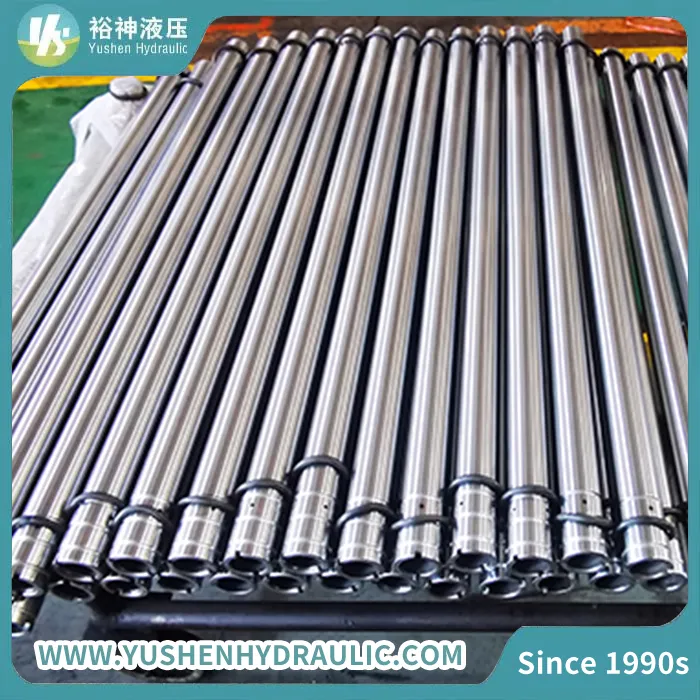
I'm a supplier of 40Cr Piston Rods, and in the world of manufacturing, getting the specs right is super crucial. Different machining parameters can really shake things up when it comes to 40Cr Piston Rods. So, I'm gonna break down how factors like cutting speed, feed rate, and depth of cut can affect these rods.
Let's start with cutting speed. It's basically how fast the cutting tool moves along the 40Cr piston rod. If you crank up the cutting speed, the material removal rate goes up too. That means you can get more work done in less time, which is great for production efficiency. But here's the catch. High cutting speeds can also generate a ton of heat. And 40Cr steel isn't a huge fan of too much heat. The excessive heat can change the material's structure, making it softer and reducing its hardness. As a result, the piston rod might not be as durable as it should be. On the other hand, if the cutting speed is too low, the production process becomes really slow. It's like trying to drive a car at 10 miles per hour on a highway - you're just not getting anywhere fast.
Next up is the feed rate. This is how far the cutting tool moves into the material for each revolution of the workpiece. A higher feed rate allows you to remove more material with each pass. It can speed up the machining process and increase productivity. But if you set the feed rate too high, the cutting forces on the tool increase. This can lead to tool wear and tear, and even cause the tool to break. Also, a high feed rate can leave a rough surface finish on the piston rod. You don't want a piston rod with a bumpy surface, right? That can affect its performance and lead to issues in the equipment it's used in. Conversely, a very low feed rate might give you a nice, smooth surface finish. However, it'll take ages to finish the machining process, and your production costs will go through the roof.
The depth of cut is another key parameter. It's how much material is removed in a single pass of the cutting tool. A larger depth of cut means you can remove more material at once, which boosts the material removal rate. But be careful! A deep cut can put a lot of stress on the cutting tool. If the tool isn't strong enough, it can break. Moreover, a large depth of cut can cause vibrations in the workpiece and the cutting tool. These vibrations can mess up the accuracy of the machining and lead to dimensional errors in the piston rod. On the flip side, a small depth of cut might ensure high accuracy, but it'll require more passes to remove all the necessary material. This, in turn, slows down the production process.
Now, let's talk about the surface quality of the 40Cr piston rod. The machining parameters we've discussed - cutting speed, feed rate, and depth of cut - all have a huge impact on surface quality. A smooth surface is essential for a piston rod because it reduces friction and wear in the hydraulic system it's part of. If the surface is rough, it can cause leaks and premature failure of the seals. By fine - tuning the machining parameters, we can achieve the desired surface finish. For example, using a moderate cutting speed, a low feed rate, and a small depth of cut can help create a smooth surface.
The dimensional accuracy of the piston rod is also important. In hydraulic systems, the piston rod has to fit precisely into the cylinder. Any deviation from the required dimensions can lead to problems like leakage, reduced efficiency, and even complete system failure. Machining parameters play a big role here too. If the cutting forces are too high due to improper settings, it can cause the workpiece to deform slightly. This deformation can result in dimensional inaccuracies. By carefully controlling the cutting speed, feed rate, and depth of cut, we can ensure that the piston rod meets the strict dimensional requirements.
At my company, we've done a lot of experiments to find the optimal machining parameters for 40Cr piston rods. We test different combinations of cutting speed, feed rate, and depth of cut to see how they affect the rods' performance. Through these tests, we've been able to develop a set of best practices for machining 40Cr piston rods. This allows us to produce high - quality piston rods that meet the needs of our customers.


Now, let me tell you about some of the related products we offer. We have Steel Hydraulic Honed Tube, which is a great option for hydraulic systems. The honed surface of these tubes ensures a smooth fit with the piston rods. We also provide Hard Chrome Plated Piston Shaft Rod. The chrome plating adds an extra layer of protection against wear and corrosion. And if you're looking for a top - notch piston rod, our Hard Chromed Hydraulic Cylinder Piston Rod is a perfect choice.
In conclusion, the different machining parameters - cutting speed, feed rate, and depth of cut - have significant effects on the 40Cr piston rod. They influence the production efficiency, surface quality, and dimensional accuracy of the rods. By carefully selecting and controlling these parameters, we can manufacture high - quality piston rods that deliver excellent performance. If you're in the market for 40Cr piston rods or any of our related products, I encourage you to get in touch with us. We're more than happy to discuss your requirements and provide you with the best solutions.