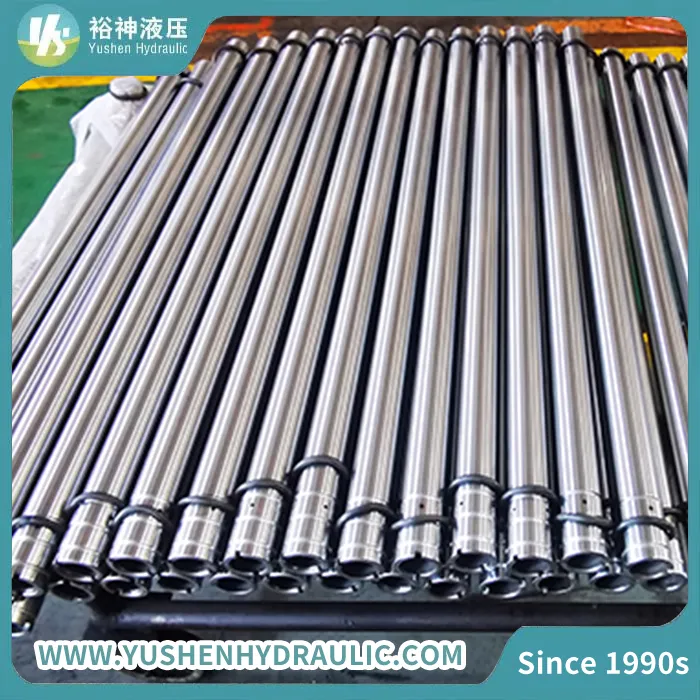
Hey there! I'm a supplier of 20MnV6 chromed rods, and today I want to dig into a pretty technical but super important topic: the heat transfer coefficient of 20MnV6 chromed rods.
Understanding the Basics of Heat Transfer Coefficient
First off, let's get clear on what the heat transfer coefficient actually is. The heat transfer coefficient, often denoted as (h), measures the ability of a material to transfer heat and remove it from a system. In simple terms, it shows how quickly heat can move through an object or from the object's surface to the surrounding environment.
This coefficient is influenced by several factors. The properties of the material itself, like its thermal conductivity, play a huge role. Other aspects, such as the fluid flow around the material (if there's a fluid involved), and the temperature difference between the material and its surroundings, also matter.
Now, when it comes to 20MnV6 chromed rods, these are made of a special alloy steel. 20MnV6 is known for its good strength, toughness, and weldability. The chrome coating on the rods further enhances their corrosion resistance and surface hardness. But how do these properties affect the heat transfer coefficient?


Factors Affecting the Heat Transfer Coefficient of 20MnV6 Chromed Rods
-
Material Composition: The composition of 20MnV6 steel has a big impact. The alloying elements in it, like manganese (Mn) and vanadium (V), change the internal structure of the steel. They can either enhance or impede the movement of heat through the material. For example, if these elements form a more ordered structure, it might make it easier for heat to be transferred, increasing the heat transfer coefficient.
-
Surface Condition: The chrome coating on the rod is a game - changer here. Chrome has high reflectivity and low emissivity. This means that it doesn't radiate heat as well as some other materials. However, a smooth chrome surface can also affect the convective heat transfer. If the flow of a fluid (like air or water) around the rod is laminar, the smooth surface can reduce the friction and allow for more efficient heat transfer. But if the flow becomes turbulent, the story might change.
-
Environmental Conditions: The temperature and flow rate of the surrounding fluid are crucial. If the rod is in a high - temperature environment, the driving force for heat transfer (the temperature difference) is large, which generally increases the heat transfer rate. Similarly, if the fluid (e.g., in a cooling system) is flowing at a high speed, it can carry away more heat from the rod's surface, increasing the effective heat transfer coefficient.
Measuring the Heat Transfer Coefficient
Measuring the heat transfer coefficient of 20MnV6 chromed rods is no walk in the park. There are several methods that scientists and engineers use:
-
Experimental Setups: One common approach is to set up a controlled experiment where the rod is exposed to a known fluid flow and temperature conditions. They measure the heat input and output, along with the temperature differences across the rod and the surrounding fluid. From these measurements, they can calculate the heat transfer coefficient using the basic heat transfer equations.
-
Numerical Simulations: Thanks to modern technology, we can also use computer - based numerical simulations. Software like ANSYS or COMSOL can model the heat transfer process in the rod and its surrounding environment. These simulations take into account all the factors we discussed earlier, like material properties, surface conditions, and fluid flow, to predict the heat transfer coefficient.
Importance of Knowing the Heat Transfer Coefficient
As a supplier, I know that understanding the heat transfer coefficient of 20MnV6 chromed rods is super important for our customers.
-
Engineering Design: In applications where heat transfer is critical, like in heat exchangers or high - performance engines, engineers need to know the exact heat transfer coefficient of the materials they are using. If they use a rod with an unknown or inaccurate heat transfer coefficient, it can lead to overheating or inefficient operation of the system.
-
Quality Assurance: For us as a supplier, accurate knowledge of the heat transfer coefficient helps us ensure the quality of our rods. We can test and verify that our products meet the required heat transfer specifications, which gives our customers peace of mind.
Related Products
We also offer other products that are related to 20MnV6 chromed rods. For high - precision applications, we have the High Precision Seamless Honed Tube. These tubes are made with high - quality materials and have a precise inner diameter, which is great for hydraulic systems.
If you're looking for something more general, our Seamless Carbon Steel Tube is a reliable option. It has good mechanical properties and is widely used in various industries. And for applications that need stronger alloys, our Alloy Steel Structural Tube made with special alloys provides high strength and good resistance.
Let's Connect
If you're interested in our 20MnV6 chromed rods or any of our other products, we'd love to hear from you. Whether you need more information about the heat transfer coefficient, want to discuss your specific requirements, or are ready to place an order, just reach out to us. We're here to help you find the perfect solution for your project.