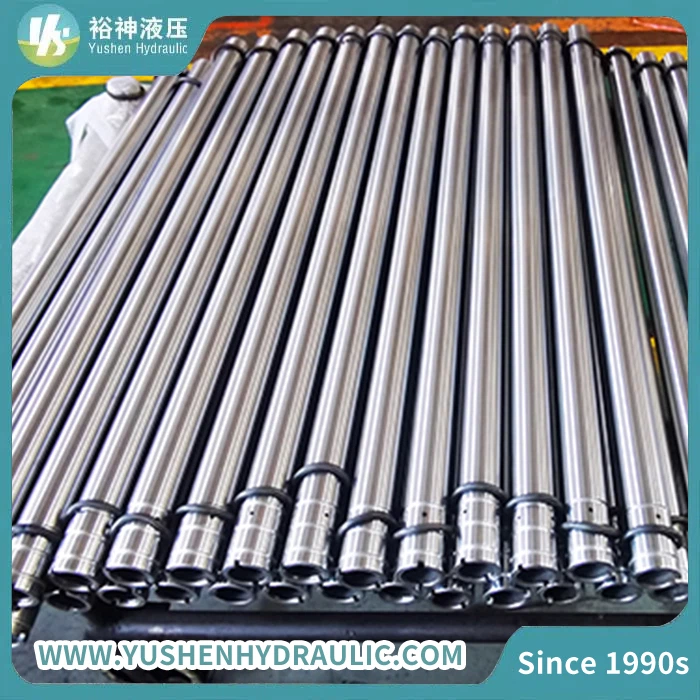
Hey there! As a supplier of 38MnV6 Chromed Rod, I often get asked about the best heat treatment for this type of rod. So, I thought I'd write a blog post to share my knowledge and experience on this topic.
First off, let's talk a bit about 38MnV6 Chromed Rod. It's a high - quality steel rod that's been chrome - plated for added durability and corrosion resistance. This rod is commonly used in a variety of applications, such as hydraulic cylinders, pneumatic cylinders, and machinery parts.
Now, when it comes to heat treatment, the goal is to improve the mechanical properties of the rod, like hardness, toughness, and wear resistance. There are several heat treatment methods that can be suitable for 38MnV6 Chromed Rod, and I'll go through them one by one.
Annealing
Annealing is a heat treatment process where the rod is heated to a specific temperature and then slowly cooled. This helps to relieve internal stresses that might have been introduced during manufacturing processes like forging or machining. For 38MnV6 Chromed Rod, annealing can also refine the grain structure, which in turn improves the ductility of the rod.
The typical annealing process for 38MnV6 might involve heating the rod to around 800 - 850°C and then letting it cool slowly in the furnace. This slow cooling rate is crucial as it allows the atoms in the steel to rearrange themselves in a more stable configuration. After annealing, the rod becomes softer and easier to machine. If you're planning to do further machining operations on the rod, annealing can be a great first step.
Normalizing
Normalizing is similar to annealing, but with a faster cooling rate. The rod is heated to a temperature above the critical point (usually around 860 - 900°C for 38MnV6) and then cooled in air. This process refines the grain structure and improves the strength and hardness of the rod compared to annealing.
Normalizing also helps to make the mechanical properties of the rod more uniform throughout its cross - section. It's a good option if you need a rod with better strength and hardness than what annealing can provide, but you don't want to go for a more extreme heat treatment like quenching and tempering.


Quenching and Tempering
Quenching and tempering is a two - step heat treatment process that can significantly enhance the mechanical properties of 38MnV6 Chromed Rod. First, the rod is heated to a high temperature (around 850 - 900°C) and then rapidly cooled, usually by immersing it in a quenching medium like oil or water. This rapid cooling creates a hard and brittle structure called martensite.
However, martensite is too brittle for most applications, so the second step, tempering, is necessary. During tempering, the quenched rod is heated to a lower temperature (usually between 200 - 650°C) and then cooled at a controlled rate. Tempering reduces the brittleness of the martensite and improves the toughness of the rod while still maintaining a high level of hardness.
This process is ideal for applications where the rod needs to withstand high loads, wear, and impact. For example, in hydraulic cylinders, a quenched and tempered 38MnV6 Chromed Rod can provide excellent performance and long - term durability.
Induction Hardening
Induction hardening is a surface - hardening process that's suitable for 38MnV6 Chromed Rod. In this process, an alternating current is passed through a coil around the rod, which generates heat in the surface layer of the rod. The heated surface is then rapidly quenched, creating a hard surface layer while keeping the core of the rod relatively soft and tough.
Induction hardening is great for applications where only the surface of the rod needs to be hard, such as in piston rods. It can improve the wear resistance of the rod's surface, which is in contact with other components, without sacrificing the toughness of the core. This helps to prevent premature wear and failure of the rod.
So, which heat treatment is the most suitable for your 38MnV6 Chromed Rod? Well, it depends on your specific application requirements. If you need a rod that's easy to machine, annealing might be the way to go. For better strength and uniformity, normalizing could be a good choice. If high - load applications are your concern, quenching and tempering might be the best option. And for surface - specific wear resistance, induction hardening is worth considering.
If you're in the market for high - quality 38MnV6 Chromed Rod, we've got you covered. We offer a wide range of Chrome Plated Rod Piston Rod that can be customized with the right heat treatment according to your needs. Our Hollow Piston Rod for Hydraulic Cylinder is also a popular choice for hydraulic applications. And if you're interested in other materials, we also have CK45 Hard Chrome Plated Piston Rod available.
If you have any questions about heat treatment or want to discuss your specific requirements for 38MnV6 Chromed Rod, don't hesitate to reach out. We're always happy to help you find the best solution for your project.
References
- ASM Handbook Volume 4: Heat Treating. ASM International.
- Metals Handbook Desk Edition, 3rd Edition. ASM International.