


Hey there! As a supplier of 40Cr piston rods, I'm super stoked to chat about the technical specifications of these bad boys. The 40Cr piston rod is a popular choice in various industries, and understanding its technical specs is crucial for getting the best performance out of it.
Chemical Composition
First off, let's talk about the chemical composition of the 40Cr piston rod. The "40" in 40Cr indicates that the carbon content is around 0.37 - 0.44%. Carbon is a key element as it affects the hardness and strength of the steel. A higher carbon content generally leads to greater hardness but also reduces the ductility.
The "Cr" stands for chromium, and it typically has a content of 0.80 - 1.10%. Chromium plays a vital role in enhancing the corrosion resistance and hardenability of the steel. It forms a passive oxide layer on the surface, protecting the rod from rust and other forms of corrosion. This is especially important in applications where the piston rod is exposed to harsh environments or corrosive substances.
In addition to carbon and chromium, 40Cr also contains small amounts of other elements such as silicon (Si), manganese (Mn), sulfur (S), and phosphorus (P). Silicon helps to deoxidize the steel during the manufacturing process and also improves its strength and hardness. Manganese enhances the hardenability and toughness of the steel. Sulfur and phosphorus are usually kept at low levels as they can have a negative impact on the mechanical properties of the steel, such as reducing the ductility and toughness.
Mechanical Properties
The mechanical properties of the 40Cr piston rod are what make it suitable for a wide range of applications. Here are some of the key mechanical properties:
- Tensile Strength: The tensile strength of 40Cr piston rods is typically in the range of 980 - 1175 MPa. Tensile strength measures the maximum stress that the rod can withstand before it breaks under tension. This high tensile strength allows the piston rod to handle significant loads and forces without failing.
- Yield Strength: The yield strength is usually around 785 MPa. The yield strength is the stress at which the rod begins to deform plastically. This means that when the stress exceeds the yield strength, the rod will not return to its original shape after the load is removed. A high yield strength is important for ensuring that the piston rod can operate within its elastic limit and maintain its integrity under normal working conditions.
- Elongation: The elongation of 40Cr piston rods is typically around 9 - 12%. Elongation is a measure of the rod's ability to stretch before it breaks. A higher elongation indicates greater ductility, which means that the rod can withstand some deformation without fracturing. This is important in applications where the piston rod may be subjected to shock loads or vibrations.
- Hardness: The hardness of the 40Cr piston rod can be adjusted through heat treatment. After quenching and tempering, the hardness can range from HB229 - 286. Hardness is an important property as it affects the wear resistance and surface durability of the rod. A harder surface can better resist abrasion and wear, which is crucial in applications where the piston rod is in contact with other moving parts.
Surface Finish and Coating
The surface finish and coating of the 40Cr piston rod are also important considerations. A smooth surface finish can reduce friction and wear between the piston rod and other components, improving the overall efficiency and lifespan of the system.
One common surface treatment for 40Cr piston rods is hard chrome plating. Hard chrome plating provides a hard, wear-resistant surface that can significantly improve the durability of the rod. The Hard Chromed Piston Rod is a great example of a product that benefits from this treatment. The chrome layer also provides excellent corrosion resistance, protecting the rod from rust and other forms of corrosion.
Another option is the Hard Chrome Steel Piston Rod, which combines the strength of the 40Cr steel with the hard chrome coating. This type of piston rod is often used in high-performance applications where both strength and wear resistance are required.
In some cases, a CK45 hydraulic piston rod may also be used. The Ck45 Hydraulic Piston Rod is made from CK45 steel, which has similar properties to 40Cr but may be more suitable for certain applications. The choice between 40Cr and CK45 depends on the specific requirements of the application, such as the load, operating conditions, and cost.
Dimensional Accuracy
Dimensional accuracy is crucial for the proper functioning of the 40Cr piston rod. The diameter, length, and straightness of the rod need to be within tight tolerances to ensure a proper fit and smooth operation.
The diameter tolerance of the piston rod is usually in the range of ±0.01 - ±0.05 mm, depending on the specific requirements of the application. A precise diameter ensures a good seal between the piston rod and the cylinder, preventing leakage and improving the efficiency of the hydraulic system.
The length tolerance is also important, especially in applications where multiple piston rods are used in series. The length tolerance is typically in the range of ±0.1 - ±0.5 mm to ensure consistent performance and proper alignment.
Straightness is another critical dimension. A straight piston rod is essential for smooth operation and to prevent uneven wear on the rod and other components. The straightness tolerance is usually specified as a maximum deviation from a straight line over a given length, typically in the range of 0.05 - 0.2 mm/m.
Processing Technology
The processing technology used to manufacture the 40Cr piston rod also affects its quality and performance. Here are some of the key processing steps:
- Forging: Forging is the first step in the manufacturing process. It involves shaping the steel billet into the desired shape of the piston rod. Forging helps to refine the grain structure of the steel, improving its strength and toughness.
- Heat Treatment: Heat treatment is a crucial step that determines the mechanical properties of the piston rod. The most common heat treatment process for 40Cr piston rods is quenching and tempering. Quenching involves heating the rod to a high temperature and then rapidly cooling it in a quenching medium, such as oil or water. This hardens the steel but also makes it brittle. Tempering is then performed to reduce the brittleness and improve the toughness of the rod.
- Machining: After heat treatment, the piston rod is machined to achieve the desired dimensions and surface finish. Machining operations include turning, grinding, and honing. Turning is used to rough out the shape of the rod, while grinding and honing are used to achieve the final dimensions and surface finish.
- Surface Treatment: As mentioned earlier, surface treatment such as hard chrome plating is often applied to improve the wear resistance and corrosion resistance of the piston rod. The surface treatment process involves cleaning the rod, applying a chrome layer, and then finishing the surface to the desired roughness.
Application Areas
The 40Cr piston rod is widely used in various industries due to its excellent mechanical properties and corrosion resistance. Here are some of the common application areas:
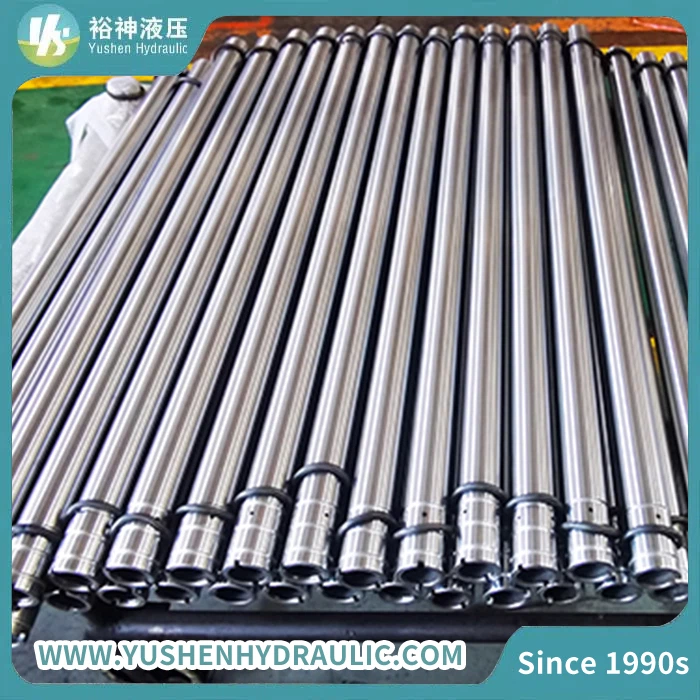

- Hydraulic and Pneumatic Systems: Hydraulic and pneumatic systems are the most common applications for 40Cr piston rods. They are used in cylinders, actuators, and other components of hydraulic and pneumatic systems to convert fluid pressure into linear motion.
- Construction Machinery: Construction machinery such as excavators, bulldozers, and cranes use 40Cr piston rods in their hydraulic systems. These piston rods need to withstand high loads and harsh operating conditions, making the high strength and wear resistance of 40Cr ideal for these applications.
- Automotive Industry: In the automotive industry, 40Cr piston rods are used in shock absorbers, steering systems, and other components. They help to provide smooth and reliable operation of these components, improving the overall performance and safety of the vehicle.
- Industrial Automation: Industrial automation systems often use hydraulic and pneumatic actuators with 40Cr piston rods. These piston rods play a crucial role in the precise control and movement of equipment, ensuring the efficiency and accuracy of the automation process.
Conclusion
So there you have it, a detailed look at the technical specifications of the 40Cr piston rod. From its chemical composition and mechanical properties to its surface finish, dimensional accuracy, and processing technology, every aspect plays a crucial role in determining its performance and suitability for different applications.
If you're in the market for high-quality 40Cr piston rods, don't hesitate to get in touch. We're a leading supplier of piston rods, and we can provide you with the best products and solutions to meet your specific needs. Whether you need standard sizes or custom-made piston rods, we've got you covered. Let's start a great partnership and make your projects a success!


