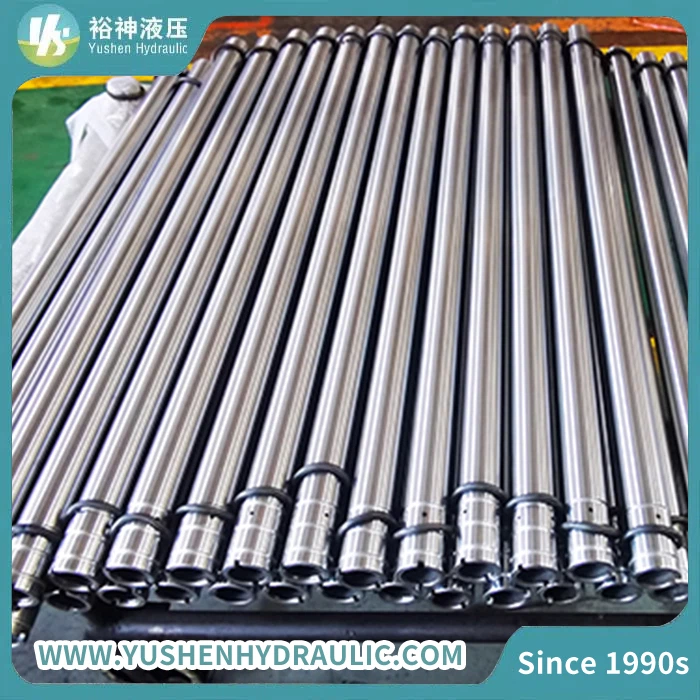
Chromed rods are widely used in various industries, especially in hydraulic cylinders, due to their excellent corrosion resistance, wear resistance, and smooth surface finish. As a chromed rod supplier, ensuring the quality of our products is of utmost importance. One crucial aspect of quality control is measuring the chroming thickness of chromed rods. In this blog post, I will discuss different methods to measure the chroming thickness and their pros and cons.
Why Measuring Chroming Thickness Matters
The chroming thickness of a chromed rod directly affects its performance and durability. A proper chroming thickness can provide sufficient protection against corrosion and wear, ensuring a longer service life of the rod. If the chroming layer is too thin, it may not offer adequate protection, leading to premature failure of the rod. On the other hand, an overly thick chroming layer can be costly and may also cause issues such as cracking or peeling. Therefore, accurate measurement of chroming thickness is essential to maintain product quality and meet customer requirements.


Methods for Measuring Chroming Thickness
1. Microscopic Measurement
Microscopic measurement is a traditional and accurate method for measuring chroming thickness. This method involves cutting a cross - section of the chromed rod and then observing it under a microscope.
- Procedure:
- First, a small sample is cut from the chromed rod. The cutting process should be carried out carefully to avoid damaging the chroming layer.
- Then, the sample is polished to obtain a smooth cross - section. This step is crucial as a rough surface can affect the accuracy of the measurement.
- After polishing, the sample is placed under a microscope. The microscope can magnify the cross - section, allowing the operator to clearly observe the chroming layer and measure its thickness using a calibrated scale within the microscope.
- Advantages:
- High accuracy. Microscopic measurement can provide very precise thickness values, often with an error margin of less than a few micrometers.
- It allows for direct visualization of the chroming layer, which can also help in detecting any defects or irregularities in the layer.
- Disadvantages:
- Destructive. Cutting a cross - section of the rod means that the sample is no longer usable. This can be a problem when dealing with expensive or limited - quantity rods.
- Time - consuming. The process of cutting, polishing, and observing the sample under a microscope is relatively slow, which may not be suitable for high - volume production environments.
2. Eddy Current Measurement
Eddy current measurement is a non - destructive method that is widely used in the industry. This method is based on the principle of electromagnetic induction.
- Procedure:
- An eddy current probe is placed on the surface of the chromed rod. The probe generates an alternating magnetic field, which induces eddy currents in the conductive chroming layer.
- The interaction between the eddy currents and the magnetic field causes changes in the impedance of the probe. These changes are related to the thickness of the chroming layer.
- The instrument connected to the probe measures the impedance changes and converts them into thickness values.
- Advantages:
- Non - destructive. Eddy current measurement does not damage the chromed rod, so the rod can still be used after the measurement.
- Fast. It can provide measurement results in a short time, making it suitable for high - volume production lines.
- Disadvantages:
- Limited accuracy compared to microscopic measurement. The accuracy of eddy current measurement can be affected by factors such as the surface roughness of the rod, the electrical conductivity of the substrate, and the presence of magnetic fields in the environment.
- Calibration is required. The instrument needs to be calibrated regularly using samples with known chroming thickness to ensure accurate measurement.
3. X - ray Fluorescence (XRF) Measurement
X - ray fluorescence measurement is another non - destructive method that can be used to measure chroming thickness. This method is based on the principle that when a sample is irradiated with X - rays, it emits characteristic X - rays whose intensity is related to the elemental composition and thickness of the layer.
- Procedure:
- The XRF instrument emits X - rays onto the surface of the chromed rod.
- The chroming layer absorbs the X - rays and emits characteristic X - rays.
- The detector in the XRF instrument measures the intensity of the emitted X - rays. Based on the calibration curve, the thickness of the chroming layer can be determined.
- Advantages:
- Non - destructive. Similar to eddy current measurement, XRF measurement does not damage the rod.
- Can measure multiple layers. XRF can also be used to measure the thickness of multi - layer coatings if present on the rod.
- Disadvantages:
- High cost. XRF instruments are relatively expensive, which may not be affordable for small - scale manufacturers.
- Safety concerns. X - rays are ionizing radiation, so proper safety measures need to be taken when using XRF instruments.
Choosing the Right Measurement Method
As a chromed rod supplier, choosing the right measurement method depends on several factors:
- Production volume: For high - volume production, non - destructive and fast methods such as eddy current measurement or XRF measurement are more suitable. They can quickly provide measurement results without affecting the production process.
- Accuracy requirements: If high accuracy is required, especially for critical applications, microscopic measurement may be the best choice, despite its destructive nature.
- Cost: The cost of the measurement method, including the cost of equipment, calibration, and operation, should also be considered. Small - scale suppliers may prefer more cost - effective methods like eddy current measurement.
Our Commitment as a Chromed Rod Supplier
At our company, we are committed to providing high - quality chromed rods to our customers. We use a combination of different measurement methods to ensure the accuracy of chroming thickness. For initial product development and quality control, we often use microscopic measurement to obtain precise thickness values. In the production process, we rely on non - destructive methods such as eddy current measurement to quickly check the chroming thickness of each rod.
We offer a wide range of chromed rods, including Hydraulic Cylinder Piston Rod Bar, Hard Chrome Steel Piston Rod for Hydraulic Cylinder, and Steel Hard Chrome Plated Rod. Our products are known for their excellent quality and performance, and we continuously strive to improve our manufacturing and measurement processes to meet the ever - changing needs of our customers.
Contact Us for Purchase and Discussion
If you are interested in our chromed rods or have any questions about chroming thickness measurement, please feel free to contact us. We are always ready to discuss your specific requirements and provide you with the best solutions. Our team of experts can offer professional advice on choosing the right chromed rod for your application and ensure that the chroming thickness meets your standards.
References
- ASTM B487 - 11(2019). Standard Test Method for Measurement of Metal and Oxide Coating Thicknesses by Microscopical Examination of Cross Sections.
- ISO 2178:2016. Non - magnetic coatings on magnetic substrates — Measurement of coating thickness — Magnetic method.
- ISO 3497:2019. Metallic coatings — Measurement of coating thickness — X - ray spectrometric methods.