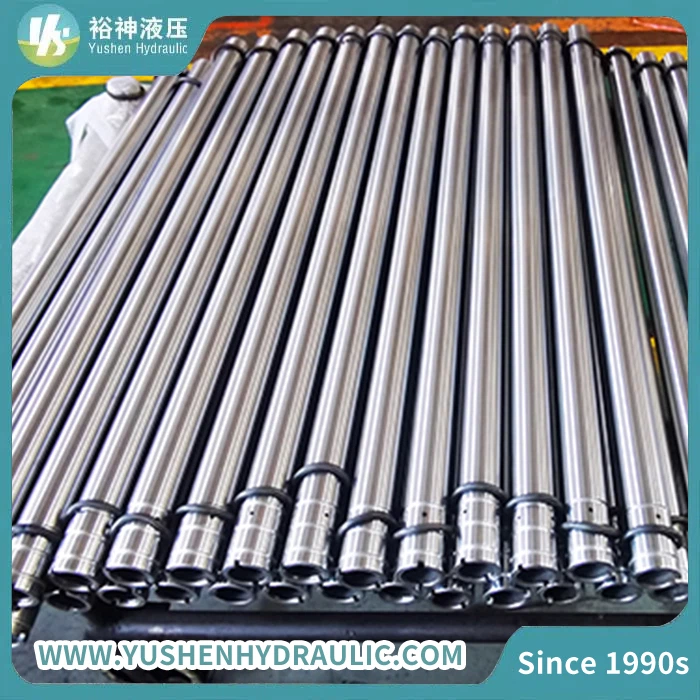
As a trusted supplier of 40Cr piston rods, I'm excited to delve into the machining process of these essential components. 40Cr is a widely used alloy steel known for its excellent mechanical properties, including high strength, good toughness, and wear resistance. These characteristics make 40Cr piston rods ideal for various applications, such as hydraulic cylinders, automotive engines, and industrial machinery.
Raw Material Selection
The machining process of 40Cr piston rods begins with the careful selection of raw materials. We source high - quality 40Cr steel bars from reliable suppliers. The chemical composition of 40Cr steel is strictly controlled to ensure it meets the required standards. Typically, 40Cr steel contains about 0.37 - 0.44% carbon, 0.80 - 1.10% chromium, and small amounts of other elements such as manganese, silicon, and sulfur. The carbon content provides strength, while chromium enhances hardenability and corrosion resistance.
Cutting and Blank Preparation
Once the raw material is received, the first step in the machining process is cutting the steel bars into appropriate lengths according to the specifications of the piston rods. This is usually done using sawing machines, which can provide accurate cuts. After cutting, the blanks are inspected to ensure they meet the length and diameter tolerances. Any surface defects on the blanks are removed through processes like turning or grinding to prepare them for further machining.
Rough Machining
Rough machining is the next crucial step. The main objective of rough machining is to remove a large amount of material quickly and shape the blank into a near - final form. This is typically carried out on lathes. The lathe rotates the blank while cutting tools are used to remove material from the outer diameter, end faces, and bore (if applicable). During rough turning, relatively large cutting depths and feed rates are used to maximize material removal rate. However, this also results in a rougher surface finish, which will be improved in subsequent processes.
Heat Treatment
After rough machining, the 40Cr piston rod blanks undergo heat treatment. Heat treatment is a critical process that significantly improves the mechanical properties of the piston rods. The most common heat treatment process for 40Cr steel is quenching and tempering.
Quenching involves heating the piston rod blanks to a specific temperature (usually around 850 - 870°C) and then rapidly cooling them in a quenching medium, such as oil or water. This rapid cooling transforms the microstructure of the steel, making it harder. However, quenching also makes the steel brittle. To reduce brittleness and improve toughness, the quenched piston rods are then tempered. Tempering is done by heating the rods to a lower temperature (usually 500 - 650°C) for a certain period and then cooling them slowly. This process relieves internal stresses and adjusts the hardness - toughness balance of the steel.
Semi - Finishing and Finishing Machining
After heat treatment, the piston rods are ready for semi - finishing and finishing machining. Semi - finishing is carried out to further improve the dimensional accuracy and surface finish of the piston rods. This is usually done on precision lathes or grinding machines. Smaller cutting depths and feed rates are used compared to rough machining to achieve better accuracy.
Finishing machining is the final step to achieve the required surface finish and dimensional tolerance. Grinding is a common finishing process for 40Cr piston rods. Surface grinding can be used to improve the flatness and surface finish of the end faces, while cylindrical grinding is used to achieve the precise diameter and roundness of the outer surface. The surface finish of the piston rod is crucial as it affects the performance and service life of the piston rod in the application. A smooth surface finish reduces friction and wear, and improves the sealing performance in hydraulic cylinders.
Hard Chrome Plating
Hard chrome plating is a common surface treatment for 40Cr piston rods. Chrome plating provides several benefits, including increased wear resistance, corrosion resistance, and improved surface hardness. The process of hard chrome plating involves immersing the piston rod in a chromic acid solution and applying an electric current. This causes chromium to deposit on the surface of the piston rod, forming a hard and smooth chrome layer.


The thickness of the chrome layer can be controlled according to the requirements of the application. For most piston rod applications, a chrome layer thickness of 0.02 - 0.05 mm is common. After chrome plating, the piston rod may undergo additional finishing processes, such as honing or polishing, to improve the surface finish and dimensional accuracy.
Quality Inspection
Throughout the machining process, strict quality inspection is carried out at each step. We use a variety of inspection tools and techniques, including calipers, micrometers, hardness testers, and surface roughness testers. Dimensional accuracy is checked to ensure that the piston rods meet the design specifications. Hardness testing is performed to verify the effectiveness of the heat treatment process. Surface roughness inspection is carried out to ensure that the surface finish meets the requirements.
Applications of 40Cr Piston Rods
40Cr piston rods are widely used in various industries. In the hydraulic industry, they are used in hydraulic cylinders for construction machinery, agricultural machinery, and industrial equipment. The high strength and wear resistance of 40Cr piston rods ensure the reliable operation of hydraulic cylinders under high pressure and heavy loads.
In the automotive industry, 40Cr piston rods are used in engines and suspension systems. They play a crucial role in transmitting power and ensuring the smooth operation of vehicles.
Related Products
If you are interested in other types of piston rods, we also offer CK45 Hard Chrome Plated Piston Rod, which is made of CK45 steel and features excellent surface hardness and corrosion resistance. Our Customized Hard Chrome Plated Rod can be tailored to your specific requirements in terms of size, surface finish, and other parameters. For applications in hydraulic cylinder cranes, our Hydraulic Cylinder Crane Piston Rod is designed to withstand heavy loads and harsh working conditions.
Contact for Purchase
If you are in need of high - quality 40Cr piston rods or any of our related products, we invite you to contact us for procurement discussions. We are dedicated to providing you with the best products and services. Our team of experts is ready to answer your questions and assist you in finding the most suitable solutions for your applications.