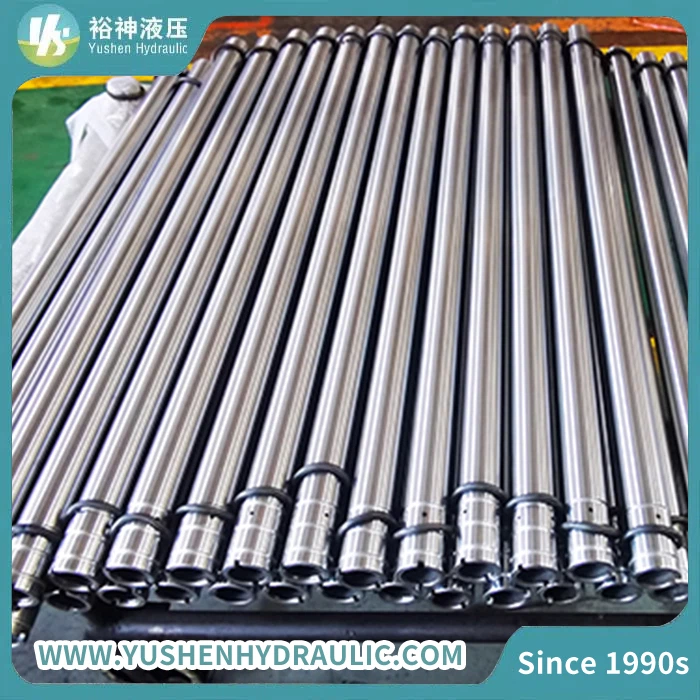
Hey there! As a supplier of Stainless Steel Piston Rods, I've seen firsthand the ins and outs of these crucial components. One question that often comes up is, "What is the effect of heat treatment on a stainless steel piston rod?" Well, let's dive right in and explore this topic.
First off, let's understand what heat treatment is all about. Heat treatment is a process where we heat and cool the stainless steel piston rod in a controlled way. This isn't just some random heating and cooling; it's a carefully orchestrated procedure that can significantly change the properties of the rod.
One of the main effects of heat treatment is on the hardness of the piston rod. When we heat the stainless steel to a specific temperature and then cool it rapidly, we can increase its hardness. This is super important because a harder piston rod can withstand more wear and tear. In applications like Hydraulic Cylinder Piston Rod systems, where the rod is constantly moving and rubbing against other parts, a hard surface can prevent premature wear.
But it's not just about making the rod hard. Heat treatment can also improve the toughness of the stainless steel piston rod. Toughness is the ability of the material to absorb energy and deform without breaking. By carefully controlling the heat treatment process, we can strike a balance between hardness and toughness. This means that the rod can handle sudden impacts and heavy loads without cracking or shattering.
Another aspect affected by heat treatment is the corrosion resistance of the piston rod. Stainless steel already has good corrosion resistance, but heat treatment can enhance it even further. When we heat treat the rod, we can modify its microstructure, which can make it more resistant to rust and other forms of corrosion. This is especially important in environments where the rod is exposed to moisture, chemicals, or saltwater. For example, in Steel Hydraulic Piston Rod applications in marine or industrial settings, a corrosion-resistant rod can last much longer and require less maintenance.


The heat treatment process can also improve the dimensional stability of the piston rod. During heat treatment, the rod undergoes some internal changes that can reduce any residual stresses. These residual stresses can cause the rod to warp or deform over time. By eliminating or reducing these stresses, we can ensure that the rod maintains its shape and size more accurately. This is crucial for applications where precise dimensions are required, such as in S45C Piston Rod systems.
Now, let's talk about the different types of heat treatment that we commonly use for stainless steel piston rods. One of the most common methods is quenching and tempering. Quenching involves heating the rod to a high temperature and then rapidly cooling it in a quenching medium, such as oil or water. This makes the rod very hard. After quenching, we temper the rod by heating it to a lower temperature and holding it there for a certain period. Tempering helps to relieve some of the internal stresses and improve the toughness of the rod.
Another method is annealing. Annealing is a process where we heat the rod to a specific temperature and then cool it slowly. This can soften the rod and improve its machinability. It can also remove any internal stresses and make the material more uniform.
So, how do we decide which heat treatment method to use? Well, it depends on the specific requirements of the application. If the rod needs to be very hard and wear-resistant, we might choose quenching and tempering. If machinability is a priority, annealing could be a better option. We also need to consider the type of stainless steel used in the rod, as different grades of stainless steel respond differently to heat treatment.
As a supplier of Stainless Steel Piston Rods, we have the expertise and equipment to perform high-quality heat treatment processes. We work closely with our customers to understand their needs and recommend the most suitable heat treatment method for their specific applications. Our goal is to provide piston rods that not only meet but exceed our customers' expectations in terms of performance, durability, and quality.
If you're in the market for Stainless Steel Piston Rods and want to learn more about how heat treatment can benefit your application, don't hesitate to reach out. We're here to answer any questions you might have and help you find the perfect solution for your needs. Whether you're looking for Hydraulic Cylinder Piston Rod, Steel Hydraulic Piston Rod, or S45C Piston Rod, we've got you covered.
In conclusion, heat treatment has a profound effect on the properties of a stainless steel piston rod. It can improve hardness, toughness, corrosion resistance, and dimensional stability. By choosing the right heat treatment method, we can optimize the performance of the rod for a wide range of applications. So, if you're looking for high-quality Stainless Steel Piston Rods, give us a call or send us an email. Let's start a conversation about how we can work together to meet your needs.
References
- ASM Handbook Volume 4: Heat Treating, ASM International
- Metals Handbook Desk Edition, ASM International